

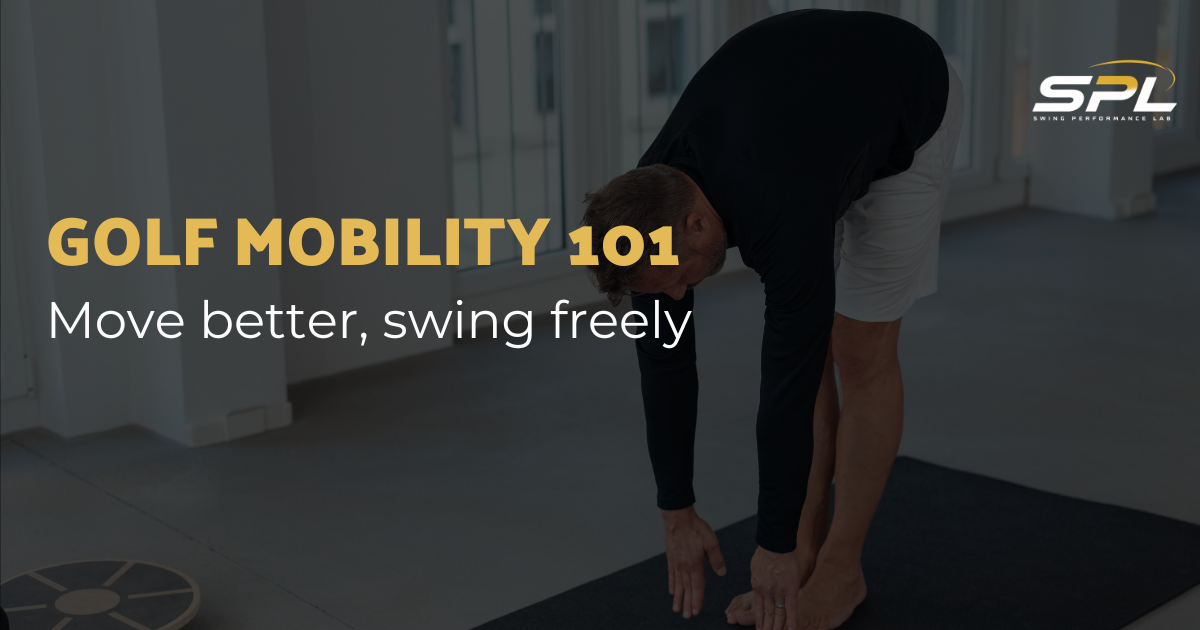
Golf Mobility 101: Why Hip and Thoracic Rotation Run Your Swing
Golf mobility is the range of motion at two specific places — your hips and your thoracic (mid) spine — that lets you turn fully away from the ball and back through it without your lower back doing work it isn't built for. It's not general flexibility, and it isn't about touching your toes. A golfer can be reasonably fit and still have a swing capped by a hip or upper back that won't rotate far enough, because mobility is joint-specific: you can have plenty of range in your shoulders and almost none in your trail hip, and the swing only cares about the joints it actually asks something of.
This guide is the mobility half of the picture — what it is, why these two joints specifically, what happens when they're restricted, and how to find out if this is your limiter before you spend six weeks training the wrong thing.
In short: Golf mobility is rotational range of motion at the hips and thoracic spine. Most amateur golfers fall short of the internal hip rotation elite players have, and when the hips or mid-back can't supply the turn, the lower back is forced to compensate — a pattern research links to both lost clubhead speed and low back pain, golf's most common injury. The fastest way to find out if mobility is your limiter is a two-minute assessment.
Table of Contents
- What "Golf Mobility" Actually Means
- The Two Joints That Matter Most
- What Happens When Rotation Is Missing
- Signs Mobility Might Be Your Limiter
- Mobility vs. Stability vs. Strength
- How Golf-Specific Mobility Training Works
- Where Mobility Fits in a Full Program
- Frequently Asked Questions
What "Golf Mobility" Actually Means
Mobility is usable, controlled range of motion at a specific joint — not how flexible you are in general, and not the same as stretching. You can stretch a muscle and still lack mobility if your body has never learned to control that range under load, which is why static stretching alone rarely moves the needle on a golfer's turn.
The swing only asks two joints to rotate a meaningful amount: the hips (especially internal rotation of the trail hip going back and the lead hip coming through) and the thoracic spine (the twelve vertebrae between your shoulder blades and your lower back). Everything else — ankles, wrists, shoulders — matters, but these two are where restriction most directly changes what the rest of your body has to do.
The Two Joints That Matter Most
Hip internal rotation is what lets your trail hip turn away from the target on the backswing and your lead hip clear on the way through, without your pelvis sliding sideways instead of rotating. It's also the single most common finding in movement screening: most amateur golfers test with hip internal rotation in the mid-30s in degrees, short of the roughly 40° threshold screening protocols use as a baseline, while tour-level players commonly test closer to 45–60°, according to the Titleist Performance Institute's screening research. That gap is a big part of why "get more hip turn" is such common advice — most golfers genuinely don't have much to give.
Thoracic rotation is what lets your upper back turn independently of your hips, creating the separation between shoulders and pelvis that generates clubhead speed — often called the X-factor. A study establishing normative values in competitive male golfers measured average thoracic rotation of roughly 36.6° to the left and 38.8° to the right, with meaningful variation between individuals (full study). The thoracic spine is naturally built to rotate more than the lumbar spine below it, which is exactly why problems start when it doesn't: the lower back is the joint most likely to make up the shortfall, and it's a poor substitute.
What Happens When Rotation Is Missing
When the hips or thoracic spine can't supply the rotation a full swing calls for, that rotation doesn't disappear from the swing — it moves somewhere else, usually the lumbar spine, which was never designed to be the primary rotating joint.
A 2015 study in the American Journal of Sports Medicine compared golfers with limited hip internal rotation against golfers with normal range and found the limited group produced significantly greater lumbar flexion and axial rotation during their swings, along with weaker hip internal rotator muscles and tighter iliopsoas and hamstrings (study summary). In plain terms: the hip didn't do its job, so the lower back did it instead, and did it under load, swing after swing.
That compensation shows up in two places:
- Lost speed. If the trunk can't rotate and separate from the hips, the arms end up doing work the body should be doing, which caps how much speed you can generate — the same X-factor mechanism covered in our guide to how a personalized golf fitness program works.
- Low back pain. Golf's most common injury has a wide reported range — somewhere between 18% and 54% of golf ailments across studies — and restricted hip and thoracic rotation forcing the lumbar spine to over-rotate is one of the leading biomechanical explanations for it.
The encouraging half of this: because it's a mechanical constraint rather than a technique flaw, it responds to targeted training. A 2025 randomized controlled trial testing a structured mobility and movement-prep program in adolescent golfers found the intervention group had a low back pain incidence of 8.8% over 12 weeks, against 33.3% in the control group — a relative risk reduction of roughly 84% (trial results). That's a specific study in a younger population, not a universal guarantee, but it's real evidence that consistent, targeted mobility work changes outcomes rather than just changing how a stretch feels.
Signs Mobility Might Be Your Limiter
You don't need a screening table to get a reasonable read on this. A few honest questions point in the same direction:
- Does your backswing feel like it runs out of room well before it feels "full," regardless of how hard you try to turn?
- Do you feel tightness or a pinch in your trail hip or lower back at the top of the backswing?
- Does your lower back ache after a round, especially the back nine, more than any other part of your body?
- Have you been told you "sway" instead of turn, or that your hips slide rather than rotate?
- Can you turn your shoulders noticeably further than your hips seem willing to allow, or the reverse?
None of these confirm a diagnosis on their own — pain and swing faults have more than one possible cause, and that's exactly the trap of guessing instead of assessing. But if several of them sound familiar, mobility restriction is a reasonable hypothesis worth testing rather than training around blind.
Mobility vs. Stability vs. Strength
It's worth being precise about the difference, because the fix for each is different and training the wrong one wastes six weeks.
- Mobility is range of motion at a joint. If you physically can't get into a position, no amount of strength or stability work gets you there — you have to open the range first.
- Stability is your ability to control a joint through the range you already have, especially under the speed and force a real swing generates. Plenty of golfers have adequate range but can't control it, which shows up as inconsistency rather than restriction.
- Strength is the force your muscles can produce once you have both the range and the control to use it.
These stack in that order — you generally can't stabilize range you don't have, and you can't fully strengthen a position you can't control. That's the whole logic behind assessing before training: a golfer who's actually stability-limited and gets handed a pure mobility program will feel looser without getting more consistent, because looseness was never the problem.
How Golf-Specific Mobility Training Works
Golf mobility work isn't generic stretching — it targets the hips and thoracic spine specifically, and it trains rotation under some degree of control rather than passive holds, because the swing needs usable range, not range you can only access lying still on a mat.
A sensible structure looks like:
- Hip internal/external rotation drills — often done from a seated or half-kneeling position, working the trail and lead hip through controlled rotation rather than a static hip-flexor stretch.
- Thoracic rotation and extension work — drills like open-books and rotational reaches that specifically isolate the mid-back from the lumbar spine, since the two are easy to move together and the point is separating them.
- Loaded or resisted rotation, later in a block, that asks the newly available range to hold up against real force — the bridge between "I can get into the position" and "I can use the position at swing speed."
The sequence matters. Early weeks build the range; later weeks load it, because range you can't yet control under speed isn't range you can actually use on the course.
Where Mobility Fits in a Full Program
Mobility is one of four physical qualities the swing draws on — alongside stability, strength, and power — and it's specifically the one that's foundational: you can't stabilize or generate power through a range you don't have access to. That's why the Mobility & Pain-Free track exists as its own dedicated program at Swing Performance Lab, built for golfers whose main limiter is stiffness, a restricted turn, or aches after a round, rather than a generic "flexibility" bolt-on to a different program.
The way to find out whether mobility is genuinely your limiter — rather than stability, strength, or power dressed up as tightness — is the same starting point covered in our guide to the golf fitness assessment quiz: a short set of questions about your level, your main complaint, and what you already know about your own body, matched against the physical qualities most likely to explain it. It takes about two minutes, and it's free.
Frequently Asked Questions
What is golf mobility, exactly?
It's usable, controlled range of motion at the joints the swing rotates through most — primarily the hips and thoracic spine. It's distinct from general flexibility because it's joint-specific and has to hold up under the speed of an actual swing, not just a static stretch.
Which matters more for golf, hip mobility or thoracic mobility?
Both matter, and they interact — a full turn needs rotation from both the hips and the mid-back. Screening research consistently finds limited hip internal rotation as one of the most common restrictions in golfers, but a stiff thoracic spine produces a very similar downstream problem: the lower back compensating for a joint above or below it that won't rotate.
Can I improve golf mobility without a coach or physio?
Yes, for most golfers. Consistent, golf-specific mobility work — done several times a week — measurably improves rotational range over weeks, and the research on structured mobility programs supports that. A professional screen is more useful once you have a specific pain or injury history to investigate, not a prerequisite for starting.
How long does it take to notice a difference?
Mobility is typically the fastest-responding physical quality — many golfers notice a fuller, more comfortable turn within the first one to two weeks of consistent work, well before strength or power changes show up.
Is limited mobility the same thing as being "not flexible enough"?
Not quite. General flexibility (touching your toes, doing the splits) doesn't reliably predict golf-specific rotational mobility. A golfer can be reasonably flexible overall and still have a genuinely restricted trail hip or thoracic spine, because those are specific joints doing specific work the rest of general flexibility doesn't test.
Does poor mobility actually cause back pain, or is that overstated?
The mechanism is well supported: when the hips or thoracic spine can't supply enough rotation, the lumbar spine is the joint most likely to make up the difference, and it's built for stability rather than repeated rotation under load. That doesn't mean every case of golf back pain is a mobility issue — it's one of several possible causes — which is exactly why assessing before training matters more than guessing.
Continue Learning
- How a personalized golf fitness program actually works — how mobility fits alongside stability, strength, and power in a matched 6-week track.
- The golf fitness assessment quiz: what it actually tells you — how the assessment finds out whether mobility is really your limiter.
Not sure if mobility is holding your swing back, or if it's something else? Take the free two-minute assessment and find out.